Currency and Credit risk

Start date: 1 September 2026
End date: Ongoing
Description
The report presents preliminary results from an empirical investigation into how the currency denomination of corporate liabilities shapes firms’ credit risk profiles. It uses a consolidated firm-level dataset combining instrument-level debt-currency information from S&P Capital IQ, harmonised financial statements from Compustat, forward-looking default probabilities from NUS-CRI, and issuer credit ratings from S&P Capital IQ. The resulting panel covers more than 44,000 firms at its 2021 peak, with observations spanning 2004–2024, and provides broad representation of both developed and developing and emerging countries (DECs).
The results document a strong and sustained increase in the relative importance of DEC firms in global corporate debt. The share of total debt accounted for by DEC firms rises from 4.8 per cent in 2004 to 42.2 per cent in 2024. This convergence is driven primarily by the growing number of firms represented in the sample rather than by convergence in firm-level debt size: median debt remains substantially higher among developed-country firms throughout the period.
Local-currency borrowing dominates corporate debt structures, but important differences emerge across markets and firm types. In developed countries, the local-currency share remains remarkably stable at approximately 85–90 per cent of total debt. In DECs, it increases substantially—from around 55–65 per cent at the beginning of the sample to approximately 86–90 per cent by 2024—while the share of USD-denominated borrowing declines sharply. This aggregate pattern, however, conceals considerable heterogeneity. Foreign-currency debt in DECs is concentrated among large firms, while smaller firms rely almost entirely on local-currency funding. Among firms with foreign-currency liabilities exceeding 10 per cent of debt, local-currency borrowing accounts for less than half of liabilities, and USD exposure remains particularly important.
The credit-risk indicators confirm that DEC firms face a riskier credit environment on average. Their one-year probabilities of default are consistently higher than those of developed-country firms, while small firms exhibit higher default probabilities than large firms in both country groups. Credit ratings show a related pattern: developed-country firms are concentrated in investment-grade categories, whereas DEC firms are more frequently assigned speculative-grade ratings.
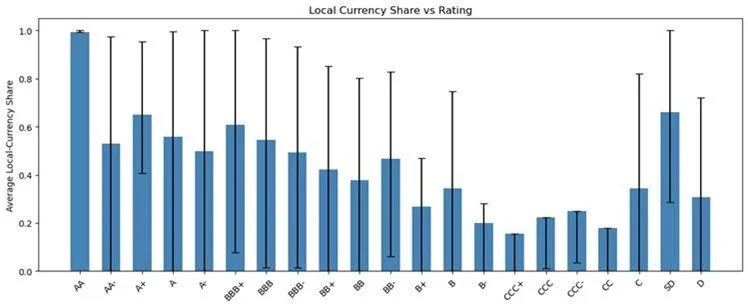
The descriptive relationship between debt currency and credit risk depends on the measure and sample considered. Among rated DEC firms, the association is pronounced: highly rated issuers rely predominantly on local-currency funding, while lower-rated and near-default firms exhibit substantially larger foreign-currency shares. In developed countries, average local-currency shares vary less systematically across rating categories, although the dispersion of currency exposures increases as credit quality deteriorates.
Local-currency debt share by credit rating (Developing and Emerging Countries only)
Source: Authors calculations based on the merging of CIQ-DS, Compustat, and S&P ratings.
Overall, preliminary analysis establishes the empirical foundation required to examine the currency risk–credit risk nexus systematically at the firm level. It demonstrates that foreign-currency exposure is unevenly distributed across countries and firms, remains concentrated among larger and more internationally integrated DEC borrowers, and is associated with weaker credit profiles in several parts of the sample. Further research will use panel methods and heterogeneity analyses to assess whether changes in foreign-currency borrowing generate persistent increases in credit risk and how these effects vary across firm, sectoral and macro-financial conditions, including exchange rate shocks.